BoltGrid
An artificial intelligence server manufacturer builds the infrastructure that turns computing power into usable machine intelligence. It is more than a company selling boxes with GPUs. These manufacturers design server platforms, integrate accelerators, optimize memory, and connect high-speed networking systems. They also manage firmware, thermal control, testing, and long-term technical support.
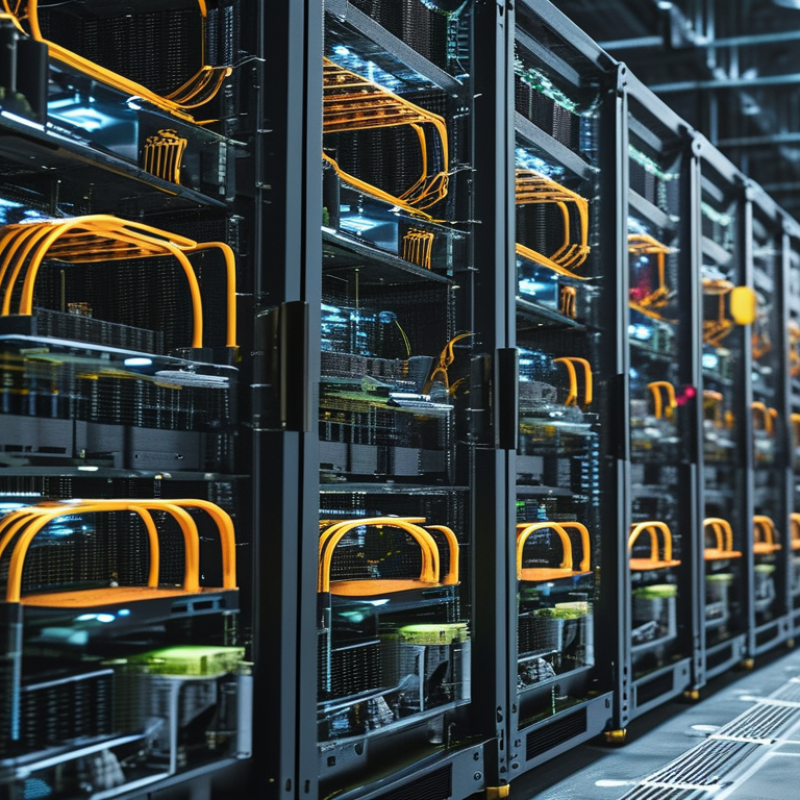
A practical example is a dense rack filled with GPU servers, liquid-cooling pipes, power distribution units, and fast data cables. Every component must work together under sustained workloads. Training a large model can expose weak airflow, unstable firmware, or insufficient power capacity within hours. Reliable manufacturers therefore test systems under realistic temperatures and heavy utilization. They publish performance data, service conditions, and compatibility limits. That transparency matters.
Jensen Huang, NVIDIA’s founder and CEO, described this transformation clearly: “The AI factory is a new type of data center—one that produces intelligence.” His statement explains why server manufacturers now influence the entire AI supply chain. Their work affects training speed, inference latency, energy use, and operational costs. Yet the label can be confusing. Some companies manufacture complete systems, while others integrate third-party processors and components. That difference deserves careful attention.
Choosing a trustworthy artificial intelligence server manufacturer requires more than comparing processor counts. Buyers should examine independent testing, warranty response, upgrade paths, cooling design, and deployment experience. Marketing numbers can look impressive. Real workloads are less forgiving. A thoughtful evaluation should also ask whether the platform fits the organization’s software, power limits, security controls, and future goals. No design is perfect. Even experienced teams discover trade-offs after deployment.
An artificial intelligence server manufacturer designs and builds hardware for AI workloads. Its role extends beyond assembling processors, memory, storage, and network components. The manufacturer studies how models train, process data, and respond to changing workloads. It then develops servers with suitable computing power, cooling systems, power delivery, and expansion options.
In practical projects, engineers may test a server with large datasets, continuous inference requests, and demanding model training. They measure response time, energy use, temperature, and system stability. These results help customers choose reliable configurations for research, healthcare analysis, manufacturing inspection, or language applications. A responsible manufacturer also provides firmware updates, maintenance guidance, documentation, and technical support. Performance numbers alone are not enough.
A fast server can still create problems if its cooling design is weak or its software support is limited. Some designs also consume more energy than expected. That trade-off deserves honest discussion.
Tips: Check workload compatibility before purchasing. Ask about thermal testing, upgrade paths, warranty coverage, and long-term support. Verify whether the server supports your preferred software environment. Request realistic benchmark results, not only ideal laboratory figures. Leave room for growth, but avoid paying for unused capacity. Small organizations may need simpler systems than they first assume. This decision can change later.
An artificial intelligence server manufacturer designs and builds systems for demanding machine learning workloads. The work involves more than assembling powerful processors. Engineers must balance computing speed, heat, energy use, storage, and long-term reliability. In practice, a server can look impressive on paper but perform poorly in a crowded data center.
High-speed accelerators provide the main processing power for training and inference. They need fast memory and wide data paths to avoid waiting for information. Advanced interconnects allow several processing units to exchange data with low delay. This matters when a model handles large images, language datasets, or video streams. Manufacturers also use high-capacity memory, fast storage, and optimized network controllers. Small delays become expensive at scale.
Thermal engineering is equally important. Dense systems often use carefully directed airflow, heat pipes, or liquid cooling. Sensors monitor temperature, voltage, fan speed, and workload changes. Firmware can adjust performance before overheating occurs. Reliable power delivery protects components during sudden demand spikes. Security features, encrypted storage, controlled access, and measured boot help protect model data. Production teams test servers with sustained workloads, not only short demonstrations. That is essential. No design is perfect. Cooling noise, maintenance space, and energy waste can still be underestimated. Engineers must review field data and revise the design instead of trusting laboratory results alone.
An artificial intelligence server manufacturer designs and builds systems for demanding model training, inference, and data processing. The work extends beyond installing accelerators in a metal chassis. Engineers select processors, high-speed memory, network adapters, storage, power supplies, and cooling hardware as one connected system.
Design starts with workload behavior. Training servers need fast communication between accelerators, while inference systems may prioritize response time and energy efficiency. According to the International Energy Agency’s Energy and AI report, data centers consumed about 415 terawatt-hours of electricity in 2024. That figure makes power planning a design requirement, not an optional upgrade.
Thermal engineering matters just as much. A manufacturer may use direct liquid cooling, stronger airflow paths, or rear-door heat exchangers for dense racks. The American Society of Heating, Refrigerating and Air-Conditioning Engineers provides thermal guidance for data-center equipment, but real deployments still require site testing. Small airflow differences can change component temperatures.
Validation is equally important. Engineers test firmware, driver compatibility, network latency, sustained workloads, and failure recovery before shipment. IDC’s Worldwide AI and Generative AI Spending Guide identifies infrastructure as a major part of enterprise AI investment, increasing pressure for dependable systems. Yet benchmark results can mislead. A server may perform well briefly but throttle after hours of training. Good manufacturers measure the uncomfortable details: noise, heat, power draw, service access, and performance under continuous load. Specifications are useful. They are not the whole truth.
What Is an Artificial Intelligence Server Manufacturer?
An artificial intelligence server manufacturer designs systems for demanding machine-learning workloads. It selects processors, accelerators, memory, storage, networking, and cooling components. It also validates firmware, power delivery, and rack-level reliability. This work matters because training failures can waste days of expensive computing time.
Types of AI servers serve different operational needs. Training servers use multiple accelerators, high-speed interconnects, and large memory pools. They support foundation-model development, scientific simulation, and image analysis. Inference servers are optimized for fast responses in chat systems, fraud detection, recommendation engines, and industrial inspection. Edge AI servers place compact computing near cameras, sensors, or factory equipment. Hybrid servers connect local resources with cloud platforms. IDC’s 2024 Worldwide AI and Generative AI Spending Guide projects worldwide AI spending will exceed 632 billion dollars by 2028. The Stanford AI Index 2025 also reports that 78% of organizations used AI in 2024. Demand is real, but capacity planning remains imperfect.
Tips: Match server type to workload behavior, not headline performance. Measure latency, memory use, cooling capacity, and power under sustained load. A training server may be wasteful for simple inference. Test with production data patterns. Small mistakes become large bills. Some published benchmarks also ignore software tuning, which deserves skepticism. Uptime Institute’s 2024 analysis highlights continuing concern about data-center power and resilience, so electrical design should be reviewed with the same care as processor selection.
| AI Server Type | What It Is | Typical Processing Hardware | Main Applications | Key Strengths | Common Deployment Environment |
|---|---|---|---|---|---|
| GPU Server | A server optimized for highly parallel mathematical operations used in machine learning and deep learning. | One or more data-center GPUs, multi-core CPUs, high-speed memory, and accelerated interconnects. | Large-model training, computer vision, natural-language processing, recommendation systems, and scientific simulation. | High throughput for matrix operations and strong support for parallel workloads. | AI research centers, cloud data centers, enterprise data centers, and high-performance computing facilities. |
| CPU-Based AI Server | A general-purpose server that runs AI workloads mainly on central processing units. | Multi-core CPUs, large system memory, storage accelerators, and optimized AI software libraries. | Classical machine learning, data preparation, inference for smaller models, analytics, and business automation. | Flexible, widely compatible, and suitable for mixed enterprise workloads. | Office data centers, private clouds, edge locations, and existing virtualization platforms. |
| AI Accelerator Server | A server using dedicated processors designed to accelerate neural-network training or inference. | Specialized AI accelerators, tensor-processing units, inference chips, or reconfigurable logic devices. | Deep-learning inference, speech recognition, image classification, fraud detection, and real-time analytics. | Potentially lower latency and better energy efficiency for supported workloads. | Cloud platforms, telecommunications facilities, enterprise AI clusters, and specialized appliances. |
| High-Memory AI Server | A server configured with substantial system memory and fast storage to handle large datasets and models. | High-memory CPUs, optional accelerators, large-capacity RAM, NVMe storage, and high-bandwidth networking. | Data preprocessing, feature engineering, graph analytics, model fine-tuning, and in-memory databases. | Reduces data movement and supports datasets that exceed ordinary server memory capacity. | Research laboratories, financial services, healthcare analytics, and enterprise data platforms. |
| Storage-Optimized AI Server | A server designed to store, retrieve, and process large volumes of training and operational data efficiently. | High-capacity solid-state or hard-disk storage, storage controllers, fast networking, and optional CPUs or accelerators. | Data lakes, image and video repositories, dataset preparation, backup, archiving, and model-serving pipelines. | Large capacity, high input/output performance, and centralized data access for AI clusters. | Enterprise data centers, research institutions, media processing facilities, and private clouds. |
| Edge AI Server | A compact or ruggedized server that performs AI processing close to data sources instead of sending all data to a central cloud. | Low-power CPUs, compact accelerators, local storage, and industrial networking interfaces. | Industrial inspection, autonomous systems, retail analytics, smart-city monitoring, and remote-site operations. | Low response time, reduced bandwidth use, and improved operation when connectivity is limited. | Factories, stores, transportation sites, hospitals, utility facilities, and other remote locations. |
| Inference Server | A server dedicated to using trained models to generate predictions, classifications, recommendations, or responses. | CPUs, GPUs, or inference accelerators configured for low latency and high request throughput. | Chatbots, search ranking, content moderation, predictive maintenance, medical imaging, and personalization. | Fast response times, predictable service capacity, and efficient production model serving. | Public clouds, private clouds, web-service data centers, and on-premises application environments. |
| Training Cluster Server | A high-performance server node designed to work with other nodes in distributed AI model training. | Multiple accelerators, high-bandwidth memory, fast node-to-node networking, powerful CPUs, and parallel storage. | Training large language models, foundation models, advanced vision models, speech models, and digital-twin systems. | Scales computational capacity across multiple servers and supports large distributed datasets. | Supercomputing centers, large cloud facilities, national laboratories, and major enterprise AI platforms. |
What Is an Artificial Intelligence Server Manufacturer?
Key Factors for Evaluating an AI Server Manufacturer
An artificial intelligence server manufacturer designs and builds systems for model training, inference, and data-intensive workloads. Evaluation should begin with measurable performance, not attractive specifications. The MLPerf Training benchmark offers a useful comparison of training speed across controlled workloads. However, benchmark results may not represent your own models, data pipelines, or cooling environment.
Check accelerator compatibility, memory capacity, network bandwidth, and storage latency. A server can contain powerful processors yet deliver weak results under real workloads. Request test records using your preferred framework and model size. Ask how performance changes after several hours of continuous operation. Stability matters.
Power efficiency deserves equal attention. The International Energy Agency’s Electricity 2024 report estimates data-center electricity use could exceed 1,000 TWh in 2026. That makes thermal design and power monitoring practical purchasing criteria. Review rack density, cooling requirements, noise, firmware controls, and failure recovery procedures. Small design details matter.
Support quality is less visible. Demand documented response times, spare-parts availability, security updates, and warranty boundaries. IDC’s 2024 Worldwide AI and Generative AI Spending Guide projects related spending above 632 billion dollars by 2028. Rapid growth can encourage rushed purchasing decisions. I would also inspect deployment references, but references can be selective. No evaluation is perfect. A transparent manufacturer should share limitations, not only peak scores.
An artificial intelligence server manufacturer designs and produces computing systems optimized for machine learning and high-performance workloads. Key evaluation areas include performance per watt, reliability, scalability, software compatibility, security, and total cost of ownership.
The chart presents a reference procurement weighting model. The percentages represent the relative importance that an enterprise buyer may assign when evaluating an AI server manufacturer; actual priorities should be adjusted to the workload, budget, and data-center environment.
: It designs and builds servers for model training, data processing, and continuous inference. It balances processors, memory, storage, networking, cooling, and power delivery.
They may support language applications, healthcare analysis, manufacturing inspection, and large dataset processing. Check compatibility before purchasing. Different workloads need different configurations.
Accelerators provide high processing power for training and inference. Fast memory and wide data paths reduce waiting during large image, language, or video tasks.
Dense systems can produce substantial heat during sustained workloads. Manufacturers may use directed airflow, heat pipes, or liquid cooling. Heat wins eventually. Poor cooling can reduce stability and shorten component life.
Engineers should test response time, energy use, temperature, and stability. Testing should include sustained workloads, not only short demonstrations. Real data center conditions may expose problems laboratory tests miss.
Possible features include encrypted storage, controlled access, and measured boot. These features help protect model data and system integrity. Security still requires proper customer procedures.
Ask about thermal testing, upgrade paths, warranty coverage, and long-term technical support. Request realistic benchmark results. Ideal figures can mislead.
It should leave room for reasonable growth without buying unused capacity. A simpler system may be enough for current workloads. More capacity is not automatically better.
Powerful servers may consume more energy than expected. Cooling noise and service access can also create practical problems. These details are easy to underestimate.
An artificial intelligence server manufacturer is a specialized company that designs, engineers, and produces high-performance computing systems for AI workloads. Its role extends beyond assembling hardware: it integrates processors, accelerators, memory, storage, networking, power systems, and cooling solutions to support demanding tasks such as model training, data analysis, computer vision, and real-time inference. Core technologies may include parallel computing architectures, high-speed interconnects, advanced thermal management, scalable storage, and intelligent system monitoring.
AI server manufacturers develop systems according to different performance, energy, and deployment requirements. Their products may include compact servers for edge environments, flexible workstations for development, dense systems for data centers, and large-scale platforms for intensive training. When evaluating a manufacturer, organizations should consider processing capability, expandability, reliability, energy efficiency, software compatibility, security, technical support, customization options, and total ownership cost. A strong manufacturer delivers balanced solutions that can adapt to evolving AI applications while maintaining stable, efficient, and manageable operations.
