BoltGrid
Choosing an AI inference server manufacturer is not simply a matter of comparing processor names. Global buyers need systems that can run models reliably, meet workload demands, and fit existing infrastructure. A server handling real-time image analysis has different needs from one serving conversational AI. Latency, accelerator memory, network bandwidth, and cooling can all affect performance. Details matter.
Andrew Ng, computer scientist and AI educator, has said, “AI is the new electricity.” His observation helps explain why inference infrastructure deserves careful attention: AI services need dependable systems after model training ends. Yet a familiar brand does not guarantee the right configuration. Buyers should examine supported accelerators, software compatibility, power use, service coverage, and upgrade options. They should also ask how manufacturers validate performance under sustained workloads, not only in short demonstrations.
This Top 10 guide introduces AI inference server manufacturers for global buyers and compares factors that influence real procurement decisions. It considers product range, technical support, deployment flexibility, and the practical demands of operating systems across different regions. No ranking is perfectly neutral. Product availability and support can change, and published specifications may not reflect every workload. Treat the list as a starting point, then confirm requirements with vendors and test configurations where possible. A careful comparison can reveal trade-offs before a rack is installed. That changes everything.
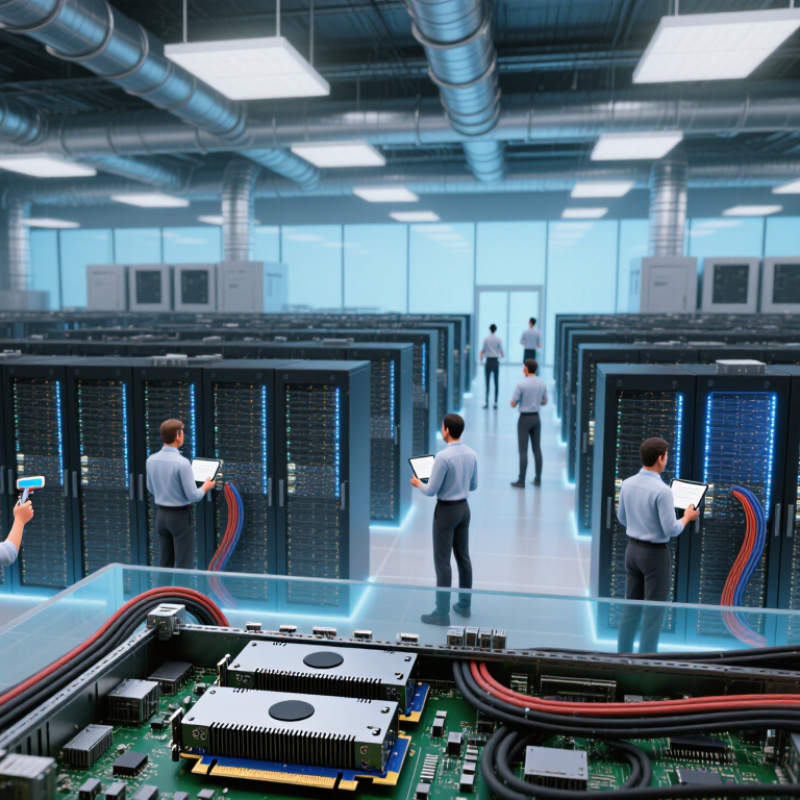
An AI inference server is a computer system that runs a trained model to answer requests. It may use CPUs, GPUs, or other accelerators, alongside memory, storage, and high-speed network connections. When someone submits a question or image, the server processes the input and returns a prediction or generated response. It is designed for inference, not for training a model from scratch. Fast responses matter. So does steady performance when many requests arrive together. For example, a server handling image analysis may need to move large image files quickly while keeping enough memory available for the model.
Choosing a capable system means looking beyond headline processing speed. Buyers should compare response latency, request capacity, memory limits, power use, and cooling needs under realistic workloads. A system that performs well in a short test may slow down during a busy afternoon. That is easy to overlook. Software configuration and network conditions also affect results, so specifications alone cannot guarantee performance. In my experience, testing with representative data is more useful than relying on a single benchmark. Even then, workloads change, and capacity estimates need regular review.
Production inference servers turn trained models into services that must respond reliably under changing demand. They receive requests, route them to available accelerators, and manage queues, memory, and response deadlines. A scheduler can group compatible requests into batches, improving hardware utilization. Oversized batches, however, may increase waiting time. Queues matter.
Stanford HAI’s 2025 AI Index reports a sharp change in inference economics. Citing Artificial Analysis data, it notes that estimated GPT-3.5-level serving costs fell from $20 per million tokens in November 2022 to $0.07 in October 2024. That is a drop of more than 280-fold. Lower prices do not remove operational trade-offs. Teams still balance first-token latency, throughput, memory use, and uptime. Long prompts and many concurrent users can strain the key-value cache. Not always.
Tips: Monitor p95 and p99 latency, not just averages. Test realistic prompt lengths and sudden traffic bursts. Keep fallback capacity available; forecasts can miss.
This buyer-oriented comparison describes ten common manufacturer and system-integration profiles, not a ranked list of named companies. Configurations are illustrative: actual accelerator counts, memory, networking, and performance depend on the selected system and workload.
| No. | Manufacturer Profile | Typical Server Configuration | Production Inference Workload | How the System Handles Workloads | Key Buyer Checks |
|---|---|---|---|---|---|
| 1 | Accelerator-server manufacturer | Rack server with one or more data-center accelerators, high-bandwidth memory, and redundant power | Large language model serving, image generation, and high-volume batch inference | Accelerators perform parallel tensor operations; serving software batches compatible requests to improve utilization while managing latency. | Supported accelerator options, memory capacity, power draw, cooling requirements, and software compatibility |
| 2 | General-purpose server manufacturer with AI configurations | Standard rack server configured with accelerators, multi-core CPUs, and high-speed networking | Mixed enterprise inference, recommendation, and computer-vision services | CPU cores handle request routing, preprocessing, and application services while accelerators run supported model operations. | CPU-to-accelerator balance, expansion slots, supported operating systems, and serviceability |
| 3 | High-density AI system manufacturer | Multi-node rack-scale system with accelerator-dense servers and fast node-to-node links | Large models or high request volumes requiring multiple servers | Model serving can distribute work across devices or nodes; the network carries coordination and, where configured, model-parallel traffic. | Interconnect bandwidth, topology, rack power, cooling capacity, and scale-out software |
| 4 | Edge-server manufacturer | Compact or short-depth server with a CPU and optional inference accelerator | Retail analytics, local vision processing, and inference close to data sources | Local processing reduces dependence on sending every input to a remote data center and can keep responses available during WAN interruptions. | Operating temperature, physical dimensions, remote management, network interfaces, and local support |
| 5 | Ruggedized computing-system manufacturer | Rugged enclosure designed for deployment in industrial or transportation environments | Machine vision, inspection, and other inference in harsh or space-constrained locations | Models run near cameras or equipment; environmental protection and deployment design support operation outside a conventional server room. | Published environmental ratings, vibration tolerance, ingress protection, and maintenance requirements |
| 6 | CPU-server manufacturer | Multi-socket or high-core-count server using CPU inference, with memory sized for the target models | Light-to-moderate inference, CPU-optimized models, and services that prioritize broad software compatibility | CPU vector instructions and multiple cores process inference without a discrete accelerator; performance depends on model, precision, and concurrency. | Memory bandwidth, supported instruction sets, model-framework support, and measured performance on the intended workload |
| 7 | Energy-efficient server manufacturer | Server platform based on power-efficient processor architectures, optionally with compatible accelerators | Scale-out inference services where power efficiency and rack-level operating cost matter | Workloads can be distributed across multiple nodes; the best fit depends on software support and throughput per watt for the target model. | Application and framework compatibility, performance-per-watt measurements, and total cost of ownership |
| 8 | Inference-accelerator system manufacturer | Server built around specialized inference accelerators, with host CPUs and system memory | Repeated, well-defined inference tasks such as image classification or selected neural-network services | Specialized hardware can execute supported operations efficiently; unsupported operators or model formats may require conversion or CPU execution. | Operator and precision support, model-conversion tools, runtime maturity, and fallback behavior |
| 9 | Storage- and data-pipeline-focused server manufacturer | Server configuration emphasizing memory, storage throughput, and network connectivity, with optional accelerators | Retrieval-augmented generation, recommendation, and inference pipelines that access external data | Inference is coordinated with retrieval, preprocessing, and storage services; reducing data movement can help avoid bottlenecks outside the model compute stage. | Storage latency, network throughput, data-protection features, and integration with the serving stack |
| 10 | Liquid-cooled AI system manufacturer | High-power server platform designed for direct liquid cooling and compatible facility infrastructure | Dense accelerator deployments with sustained, compute-intensive inference demand | Liquid cooling transfers heat through a cooling loop, helping support dense configurations when the data-center facility is designed for it. | Cooling-loop design, facility water conditions, maintenance procedures, leak monitoring, and service support |
Comparing inference server manufacturers requires more than reading peak performance figures. Ask for benchmark results using your expected model sizes, batch patterns, and response-time targets. A server tested on a large batch may perform differently when handling many brief requests. Check whether results include power use and software configuration.
Hardware fit matters. Review accelerator options, memory capacity, bandwidth, and expansion limits. Then check network throughput and storage performance, especially if models or datasets move frequently. Ask how cooling is managed in a dense rack, and measure noise and power draw where the system will operate. Small details count. A useful evaluation includes service access, replacement-part availability, warranty terms, and the time needed to restore a failed unit.
Software and support deserve equal attention. Confirm compatibility with your inference framework, container environment, and monitoring tools. Request a clear update policy and evidence of tested configurations, not just a broad compatibility claim. A tidy spec sheet can still mislead. Compare measured results, but leave room for doubt: a short benchmark may miss traffic spikes or long-running thermal limits. A practical pilot with representative workloads often reveals issues that a sales presentation cannot.
Global buyers comparing AI inference server manufacturers should look beyond headline accelerator counts. A compact edge system and a rack-scale server solve different problems. Start with the workload: model size, concurrent requests, response-time targets, and expected growth. Then ask manufacturers for benchmark results using comparable software, batch sizes, and power limits. Apples-to-apples testing matters.
Check the hardware details. Memory capacity and bandwidth affect how many model weights fit and how quickly they can be accessed. Network speed, storage throughput, and cooling design also shape real performance. Ask for measured power draw under sustained inference, not only peak specifications. Small details matter. A loud rack or frequent thermal throttling can disrupt a quiet deployment room. Request service response times, spare-parts locations, firmware update policies, and warranty terms for each destination market.
A useful top-ten comparison should score manufacturers consistently rather than declare one universal winner. Review integration support, operating-system compatibility, remote management, and documented security controls. Confirm that local teams can install and maintain the system. For international shipments, verify applicable electrical and environmental certifications with the supplier; requirements differ by region. Pilot testing remains valuable. I would still leave room for doubt: published benchmarks rarely reproduce every production workload, and a carefully chosen configuration can outperform a more expensive one. Ask for a trial with representative traffic before committing to a large order.
An inference server should fit the workload, not just look powerful on a specification sheet. Estimate daily requests, peak concurrency, and acceptable response time. A support assistant may need quick replies with small batches, while image analysis may benefit from larger accelerators and more memory. Check model size, precision options, and the software frameworks your team already uses. During evaluation, test with representative prompts and real traffic patterns. A brief benchmark can mislead.
Tips: Record power draw, memory use, and latency during peak load. Ask for service and parts availability in your region. Leave headroom for model updates.
Also check the room around the server. A dense configuration can require more cooling, rack space, and electrical capacity than expected. Review network bandwidth if data arrives from remote sites; a fast accelerator cannot fix a slow connection. Compare total operating costs, not only purchase price. One detail teams sometimes miss is maintenance access: crowded racks make routine work harder. Requirements may change after deployment, so document assumptions and revisit them. The perfect fit is not always obvious.
Estimated memory needed for model weights at two common numerical precisions
Estimates are calculated from parameter count × bytes per parameter: FP16 uses 2 bytes and INT8 uses 1 byte. Values use decimal GB and cover model weights only; actual server memory requirements are higher because runtime overhead and the KV cache are not included.
Ask for tests using your model sizes, batch patterns, and response-time targets. Include power use and software settings. Short tests miss traffic spikes.
Estimate daily requests, peak concurrency, and acceptable latency. Check accelerator options, memory capacity, bandwidth, and expansion limits. Bigger is not always better.
Many brief requests can behave differently from one large batch. Test representative prompts under peak load. A polished demo proves little.
Record latency, memory use, and power draw. Check noise and cooling in the room where the server will run. Small details matter.
Review network throughput, storage speed, rack space, and electrical capacity. A slow remote connection can hold back a fast accelerator.
Ask about local service, replacement parts, warranty terms, and repair time. Check whether technicians can reach the server in a crowded rack.
Confirm compatibility with your inference framework, containers, and monitoring tools. Request tested configurations and a clear update policy. Broad claims are not enough.
Include power, cooling, and maintenance, not just purchase price. Leave room for model updates. My estimate could still be wrong, so revisit it after deployment.
An AI inference server is a purpose-built system that runs trained models to generate predictions, recommendations, or other outputs in response to live requests. In production, it must handle changing traffic levels while balancing response time, throughput, reliability, and efficient use of compute resources. Comparing manufacturers therefore involves more than processor specifications: buyers should also consider supported workloads, accelerator and memory options, software compatibility, cooling and power requirements, scalability, service, and total cost of ownership.
This overview introduces ten categories of AI inference server manufacturers for global buyers and explains how to assess their offerings without relying on brand names alone. The right ai inference server manufacturer depends on the organization’s model types, deployment environment, expected request volume, performance targets, budget, and growth plans. By matching these needs to a system’s architecture and support capabilities, businesses can narrow their options and choose infrastructure suited to dependable, cost-conscious AI services.
