BoltGrid
Choosing a data center AI server manufacturer is not simply a hardware decision. It shapes performance, reliability, operating costs, and future expansion. A suitable partner understands more than GPU specifications. It studies workload patterns, power limits, cooling capacity, network design, and maintenance requirements.
Jensen Huang, founder and CEO of NVIDIA, has stated, “The future of computing is accelerated computing.” His observation reflects a practical reality. AI servers must process enormous datasets while maintaining stable performance under sustained workloads. A capable data center AI server manufacturer can recommend balanced configurations, including GPUs, CPUs, memory, storage, high-speed networking, and efficient power delivery.
Details matter.
For example, an enterprise cluster may require liquid cooling, redundant power supplies, and fast interconnects between nodes. Poor component matching can create bottlenecks, even when premium GPUs are installed. Experienced manufacturers also provide firmware validation, deployment guidance, remote monitoring, and long-term technical support. These services reduce avoidable downtime and simplify future upgrades.
Still, no manufacturer is perfect. Marketing claims may sound impressive, yet real-world results depend on software, facility design, and operator expertise. Buyers should request test data, service-level commitments, warranty terms, and references from comparable deployments. Independent evaluation remains necessary.
The strongest choice combines engineering knowledge with transparent communication. It should explain trade-offs clearly, not merely promote the most expensive system. When performance, energy use, security, and lifecycle costs are evaluated together, selecting a data center AI server manufacturer becomes a strategic infrastructure decision rather than a simple purchasing exercise.
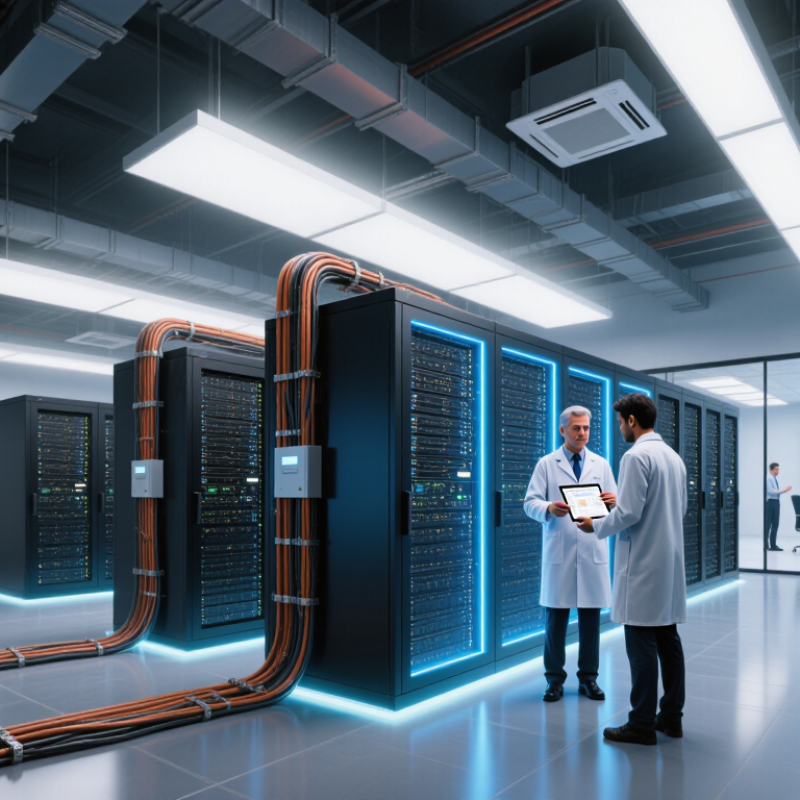
A data center AI server manufacturer designs, builds, tests, and supports computing systems for demanding artificial intelligence workloads. It works with GPU servers, high-speed networking, storage, power systems, and cooling equipment. Unlike a basic equipment reseller, the manufacturer helps shape the complete platform around a facility’s workload and limits.
In practical projects, engineers may review model sizes, training schedules, rack space, and electricity capacity before recommending a server configuration. They can test thermal performance under sustained loads, inspect firmware stability, and verify communication between accelerators. Small details matter. A loose cable or poorly planned airflow path can reduce performance and increase maintenance risk. Reliable manufacturers document test results, publish clear specifications, and provide service procedures that technicians can follow during a night shift.
The role also includes long-term planning. AI workloads change quickly, so a useful manufacturer should consider expansion, component compatibility, data protection, and lifecycle costs. No design is perfect. A configuration optimized for training may perform poorly for real-time inference. A rushed specification can also create unnecessary energy expenses. Experienced teams therefore ask difficult questions and revise assumptions before delivery. Their value is not limited to assembling hardware; it comes from applying engineering knowledge, operational experience, and accountable support to a measurable data center environment.
AI server manufacturers design hardware around data center realities, not only benchmark scores. High-density accelerators can create intense heat inside a single rack. Therefore, engineers combine liquid cooling, wider airflow paths, and intelligent fan control. The International Energy Agency reported that data centers consumed about 460 terawatt-hours of electricity in 2022. That demand could exceed 1,000 terawatt-hours by 2026. Efficiency is no longer optional.
A specialized manufacturer also studies power delivery, network latency, and maintenance access. For example, redundant power modules can reduce downtime during component failures. Hot-swappable drives and clearly arranged cabling help technicians work faster. Uptime Institute’s 2024 Annual Outage Analysis found that 54% of serious outages caused at least 100,000 dollars in direct losses. Small design decisions matter. Very much.
Reliable systems require thermal testing under sustained workloads, not brief laboratory bursts. Manufacturers should validate GPU utilization, memory pressure, vibration, and cooling performance together. They should also provide telemetry for temperature, power draw, and fan behavior. A useful design exposes problems early. Still, no architecture is perfect. Liquid cooling adds plumbing, monitoring, and maintenance responsibilities. That trade-off deserves honest discussion before deployment, especially when older facilities lack suitable water systems.
High-performance AI servers are defined by balanced technologies, not accelerator count alone. The Stanford AI Index Report 2025 shows that leading AI systems require rapidly expanding computing resources. That pressure makes high-bandwidth memory essential. It keeps data moving between processors and memory, reducing idle time during training and inference.
Fast interconnects matter too. A server should link accelerators with low-latency fabrics, while PCIe expansion supports storage and networking upgrades. Liquid cooling is becoming equally important. The International Energy Agency reported that data centers consumed about 415 TWh of electricity in 2024, with demand potentially reaching 945 TWh by 2030. Dense AI racks need direct cooling paths, carefully measured airflow, and efficient power delivery. Heat cannot be solved by software.
Reliability is easy to underestimate. Redundant power supplies, error-correcting memory, remote monitoring, and predictive maintenance protect long training jobs. Security controls should cover firmware, access, and model data. I have seen impressive hardware lose value because cooling capacity was planned too late. That mistake remains common. The Uptime Institute’s Global Data Center Survey highlights continuing concerns about power availability and operational resilience. A capable manufacturer therefore tests complete systems, not isolated components. Performance numbers can look excellent in a laboratory. Real workloads are less polite.
| Technology Dimension | Core Technology | Typical Enterprise-Grade Specification | Performance and Data Center Value | Key Evaluation Point |
|---|---|---|---|---|
| AI Compute | Accelerator Architecture | Dedicated GPUs, AI accelerators, or other parallel processors with high-bandwidth memory and matrix-computation support | Accelerates training, inference, scientific computing, and large-scale data processing | High |
| Memory Subsystem | High-Capacity ECC Memory | ECC system memory sized for model parameters, datasets, preprocessing, and concurrent workloads | Reduces data movement bottlenecks and helps maintain reliable long-duration operation | High |
| Accelerator Memory | High-Bandwidth Memory | HBM or equivalent accelerator memory with substantially higher bandwidth than conventional system memory | Improves throughput for tensor operations, model training, and memory-intensive inference | High |
| Interconnect | High-Speed GPU-to-GPU and CPU-to-GPU Links | Low-latency interconnects designed for peer-to-peer communication and fast collective operations | Limits communication overhead when multiple accelerators share a workload | High |
| Network Fabric | High-Bandwidth, Low-Latency Networking | Data center Ethernet or InfiniBand-class networking with speeds commonly ranging from 100 Gb/s to 400 Gb/s in advanced clusters | Supports distributed training, shared storage access, and rapid movement of large datasets | High |
| Storage | NVMe-Based Storage | PCIe-connected NVMe solid-state storage with high IOPS and low latency, combined with scalable shared storage where required | Speeds up dataset loading, checkpointing, container deployment, and inference pipelines | High |
| Power Delivery | High-Efficiency Power Supply Design | Redundant server power supplies sized for sustained accelerator loads and data center power standards | Improves availability and reduces energy loss during intensive workloads | High |
| Thermal Management | Advanced Air or Liquid Cooling | High-airflow cooling for conventional configurations; direct-to-chip liquid cooling for dense, high-power systems | Controls component temperature, reduces thermal throttling, and enables higher rack density | High |
| Reliability | Redundant and Serviceable Architecture | Hot-swappable drives, redundant power, error detection, remote management, and replaceable components | Minimizes downtime and simplifies maintenance in continuous-operation environments | High |
| Management | Out-of-Band Server Management | Remote monitoring and control for hardware health, firmware, power, thermals, and event logs | Enables centralized administration and faster diagnosis without physical access | Medium |
| Software Stack | AI Framework and Container Compatibility | Support for Linux-based environments, containers, orchestration platforms, and widely used machine-learning frameworks | Shortens deployment time and improves portability across development and production environments | High |
| Scalability | Modular Cluster Expansion | Standardized nodes, scalable network topology, and compatible rack, power, and cooling infrastructure | Allows compute capacity to grow as model size, users, and data volume increase | High |
| Security | Hardware and Firmware Security | Secure boot, signed firmware, access control, trusted platform functions, and auditable management interfaces | Protects models, data, system software, and administrative access | High |
| Lifecycle Support | Validation, Integration, and Technical Service | System-level testing for firmware, drivers, accelerators, networking, storage, cooling, and workload compatibility | Reduces integration risk and provides a clearer path from prototype to production deployment | High |
Specialized AI server manufacturers provide more than assembled hardware. They engineer complete systems for accelerator density, high-speed networking, memory bandwidth, and thermal control. This matters because the International Energy Agency’s Energy and AI report estimates that data centers consumed about 415 terawatt-hours of electricity in 2024. Demand could exceed 945 terawatt-hours by 2030. A poorly balanced server wastes power quickly.
Experienced manufacturers also validate airflow, rack layouts, firmware, and workload performance before deployment. They can match liquid cooling systems to sustained training loads, rather than relying on ordinary enterprise configurations. The Uptime Institute’s Global Data Center Survey 2024 identifies power availability and rising rack density as major operational challenges. Specialized engineering directly addresses both problems. Small details matter, such as cable paths, service access, and fan behavior during peak inference.
Reliable support is equally important. A capable supplier provides burn-in testing, component traceability, remote diagnostics, and documented replacement procedures. These practices reduce uncertainty when a server fails at 2 a.m. They also help operators plan capacity with measurable performance data. Still, specialization is not a guarantee of perfection. Cooling designs can become difficult to maintain, and benchmark results may not reflect every real workload. Buyers should request independent test evidence, energy measurements, and clear warranty terms before committing. Performance claims deserve scrutiny.
Selecting an AI server manufacturer requires more than comparing processor counts. Examine its deployment experience, engineering depth, and support process. Ask for documented performance results from workloads similar to yours. Training models, inference services, and scientific simulations create different demands. A convincing supplier should explain these differences clearly.
Inspect the hardware details closely. Review accelerator compatibility, memory capacity, cooling design, power limits, and rack density. Request thermal test data under sustained workloads, not only short benchmark runs. Check whether the manufacturer provides remote monitoring, firmware updates, spare parts, and on-site response options. A useful evaluation includes a live demonstration. Listen for fan noise. Watch temperature changes. Measure power consumption at the rack.
Reliability also depends on people and procedures. Request customer references, service-level terms, warranty conditions, and failure-response records. Verify relevant safety, electromagnetic, and energy-efficiency certifications for your region. Transparent documentation matters. Vague claims deserve careful questions. One lesson from real deployments is uncomfortable: the fastest server is not always the most practical choice. A complex platform may increase maintenance time and training costs. I would also leave room for mistakes, because workload growth is difficult to predict. Select a manufacturer willing to test your actual data pipeline before purchase, even if the results reveal weaknesses.
It designs, builds, tests, and supports servers for demanding AI workloads. It also plans networking, storage, power delivery, and cooling. Small details matter. A loose cable can reduce performance and increase maintenance risk.
Engineers should study model size, training schedules, rack space, and available electricity. They should also review maintenance access and network latency. A strong design fits the facility, not just a benchmark chart.
High-density accelerators generate intense heat inside a rack. Liquid cooling, wider airflow paths, and intelligent fans can control temperatures. Liquid systems also add plumbing and monitoring duties. That trade-off should be discussed clearly.
Request thermal tests under sustained workloads, not brief laboratory bursts. Testing should examine GPU use, memory pressure, vibration, power draw, and cooling together. Telemetry should show temperature and fan behavior. Short tests can mislead.
Compare deployment experience, engineering depth, support procedures, and similar workload results. Ask how training, inference, and scientific simulations affect the configuration. A live demonstration can reveal noise, heat changes, and rack power use. Watch carefully.
Check accelerator compatibility, memory capacity, cooling design, power limits, and rack density. Review firmware updates, spare parts, remote monitoring, and on-site response options. Cabling should be clear enough for night-shift technicians. That detail is easy to underestimate.
Request customer references, warranty conditions, service-level terms, and failure-response records. Confirm regional safety, electromagnetic, and energy-efficiency certifications. Clear documentation helps technicians act during an outage. Vague promises need questions.
No. A faster system may consume more energy or require harder maintenance. Complex platforms can increase training costs and repair time. Workload growth is difficult to predict. Leave room for mistakes.
Choosing a data center ai server manufacturer is essential for organizations that need reliable, scalable, and efficient computing infrastructure for artificial intelligence workloads. Unlike general server suppliers, specialized manufacturers design systems specifically for intensive model training, inference, data processing, and high-performance computing. Their solutions typically integrate powerful processors, advanced accelerators, high-speed memory, optimized networking, efficient cooling, and flexible storage to support demanding data center environments.
A capable manufacturer also provides value beyond hardware. It can help customers select suitable configurations, improve energy efficiency, simplify deployment, and maintain stable performance as workloads grow. When evaluating an AI server manufacturer, organizations should consider hardware compatibility, scalability, thermal design, power consumption, security features, system management tools, quality control, technical support, customization options, and long-term service capabilities. By comparing these factors carefully, businesses can choose infrastructure that delivers dependable performance, supports future expansion, and aligns with operational and budget requirements.
